what a web we weave when we practice to deceive
| Marmion: A Tale of Flodden Field | |
|---|---|
| by Sir Walter Scott | |
 Get-go edition title page | |
| Written | 1806-1808 |
| Country | Scotland |
| Form | Narrative |
| Meter | Iambic tetrameter |
| Publisher | Archibald Constable, Edinburgh William Miller, and John Murray, London |
| Publication date | 22 February 1808 |
| Preceded by | The Lay of the Last Minstrel |
| Followed past | The Lady of the Lake |
| Read online | Marmion: A Tale of Flodden Field at Wikisource |
Marmion: A Tale of Flodden Field is a historical romance in verse of 16th-century Scotland and England by Sir Walter Scott, published in 1808. Consisting of 6 cantos, each with an introductory epistle, and copious antiquarian notes, it concludes with the Battle of Flodden in 1513.[1]
Background [edit]
The introductory epistle to the first canto of Marmion is internally dated November, and there is no reason to doubt that it was written in that month of 1806.[2] At this time Scott was entering into correspondence with the Durham antiquary Robert Surtees, and in Dec they discussed the account given by Robert Lindsay of Pitscottie of the supernatural summons of James IV and several of his nobles to announced before Pluto, which Scott uses in the fifth canto: Scott refers to his developing poem, so it is clear that the overall shape of the piece of work was clear from the offset. Moreover, Surtees sent Scott 2 forgeries of his own, an account in Latin of a ghostly combat and a ballad, both of which besides appear in the poem.[iii]
On 30 January 1807 Archibald Constable concluded an agreement to pay 1,000 guineas (£ane,050) for the copyright: the sum may have originated with Scott in previous negotiations with Longman.[four] William Miller and John Murray each agreed to take a 25% share in the project.[v] Murray observed: "We both view information technology equally honourable, profitable, and glorious to be concerned in the publication of a new poem past Walter Scott."[6] Scott said that he thoroughly enjoyed writing the work. He told his son-in-law, Lockhart: "Oh, man, I had many a thou gallop among these braes when I was thinking of Marmion."[6] The poem took much longer to compose than Scott had hoped: he was held up past personal and family unit difficulties and other occupations, and information technology was probably January 1808 before it was finished.[vii]
Editions [edit]
Marmion was published in Edinburgh by Archibald Lawman on 22 February 1808, and in London past William Miller and John Murray on 8 March. It toll one and a half guineas (£ane 11s 6d), and two,000 copies were printed.[8] Scott produced small refinements for the text of the verse and larger updatings for the notes in the second edition and third editions (3,000 copies each) published later in the year.[ix] Many farther editions followed, both private and collected, and in 1830 Scott provided the verse form with a new introduction.[10]
In 2018 Ainsley McIntosh produced a critical edition of Marmion: A Tale of Flodden Field as the 2nd volume (the first to appear) of The Edinburgh Edition of Walter Scott'south Poesy, published by Edinburgh University Press. This takes the third edition equally its re-create-text and corrects it mainly from the manuscript and the first edition.
Plot [edit]
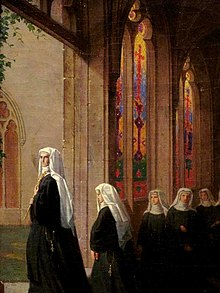
The poem tells how Lord Marmion, a favourite of Henry Viii of England, lusts for Clara de Clare, a rich woman. He and his mistress, Constance De Beverley, forge a letter of the alphabet implicating Clare'southward fiancé, Sir Ralph De Wilton, in treason. Constance, a dishonest nun, hopes that her help will restore her to favour with Marmion. When De Wilton loses the duel he claims in club to defend his accolade against Marmion, he is obliged to become into exile. Clare retires to a convent rather than gamble Marmion'due south attentions.
Constance's hopes of a reconciliation with Marmion are dashed when he abandons her; she ends upwards being walled up live in the Lindisfarne convent for breaking her vows. She takes her revenge by giving the Abbess, who is one of her three judges, documents that bear witness De Wilton's innocence. De Wilton, having returned disguised as a pilgrim, follows Marmion to Edinburgh where he meets the Abbess, who gives him the exonerating documents. When Marmion's host, the Earl of Angus (Archibald Douglas) is shown the documents, he artillery De Wilton and accepts him as a knight again. De Wilton's plans for revenge are overturned past the Battle of Flodden. Marmion dies on the battlefield, while De Wilton displays heroism, regains his laurels, retrieves his lands, and marries Clare.[11]
Canto summary [edit]
Introduction to Canto 1 (To William Stewart Rose, Esq.): Writing in Nov, Scott considers possible remedies for the destructive effect of time in the natural earth, in public affairs (he elegises Nelson, Pitt, and Fox), and in literature: namely bound, the apocalypse, and the revival of medieval romance.
Canto 1 (The Castle): The English knight Marmion and his train are received by Sir Hugh the Heron at Norham Castle who arranges for a palmer to guide him on his embassy from Henry VIII to James 4, King of Scots in Edinburgh.
Introduction to Canto two (To the Rev. John Mariot): Scott considers remedies for historical reject and personal loneliness, namely the joy Mariot and he accept establish in humble enjoyments, and the purity of solitary meditation.
Canto ii (The Convent): The Abbess of Whitby, with a party of nuns including a novice Sister Clare, journeys by sea to Lindisfarne, where she forms one of a tribunal in sentencing Constance de Beverly to be immured live together with an accomplice in the planned murder of Clare. In her final voice communication Constance tells how she had escaped from a convent to join Marmion who had then abandoned her for the wealthy Clare, charging Clare'southward fiancé with treason and defeating him in armed combat.
Introduction to Canto 3 (To William Erskine): Scott defends his intuitive, ever-varying poetry, taking its inspiration from his experience of the Borders every bit a young child, against Erskine'due south advancement of elevated classical elegy and tragedy.
Canto 3 (The Hostel, or Inn): Staying overnight at the inn at Gifford, Marmion is disconcerted when his squire Fitz-Eustace sings a favourite song of Constant (Constance'due south proper noun when she had accompanied him disguised equally a folio), and besides by the stern looks of the palmer. The host tells of a local elfin spirit who offers gainsay to all comers. Fitz-Eustace observes Marmion leave to encounter the spirit and render at speed with tell-tale signs of combat.
Introduction to Canto 4 (To James Skene): Writing again in November, a year having passed since the first introduction, Scott laments the passing of the youthful companionship enjoyed by Skene and himself, but takes condolement from their more mature acceptance of the diverseness of feel allotted by Sky.
Canto iv (The Camp): Sir David Lindsay meets Marmion on the road and arranges for the delegation to receive supervised accommodation at Crichton Castle till James is fix to receive him. Lindsay tells Marmion that a supernatural effigy resembling St John has (unavailingly) urged the king against war with England. In response Marmion tells of his supernatural combat at Gifford. Approaching Edinburgh, Marmion surveys from Blackford Hill the assembled Scottish forces as Lindsay deplores the move towards war.
Introduction to Canto 5 (To George Ellis): Writing in December from Edinburgh, Scott asserts that the metropolis is more liberal than in medieval times, but just as secure. Ellis is an example to Scott of how medieval literature can exist restored and rendered relevant to the modern world.
Canto 5 (The Court): Passing through the Scottish forces, Marmion is received past James (in thrall to his mistress Lady Heron and the Queen of French republic) who commits him to the keeping of the pacific Archibald Douglas at Tantallon Castle and asks him to take charge of the group of English nuns from Canto 2 captured by a Scottish galley. The abbess meets the palmer at night and entrusts him with papers deriving from Constance proving Marmion'southward role in the false accusation of De Wilton which she had abetted in society to gain influence over him. At Tantallon Marmion, who has been entrusted with returning Clare to her kinsman Lord Fitz-Clare, hears with impatience of the build-upward towards battle.
Introduction to Canto 6 (To Richard Heber): Writing from Mertoun at Christmas, Scott celebrates the festive occasion maintaining ancient family traditions, and asserts the imaginative ability of the superstitions recorded in the old books amassed by the bibliophile Heber.
Canto 6 (The Boxing): De Wilton appears to Clara at Tantallon and tells how he disguised himself as the palmer. He is knighted by Douglas. Marmion joins Surrey's forces at Flodden and dies of wounds received in the battle, tended by Clare, who is then united with Lord Fitz-Clare. Marmion's trunk is dislocated with that of a peasant and buried in an unmarked grave. Clare and De Wilton marry.
Reception [edit]
Many of the reviewers judged Marmion equal in merit to The Lay of the Last Minstrel, though displaying different qualities:[12] 1 critic for example thought that it 'is less sprightly, and less fanciful, but information technology is more heroic and more stately'[13] But the tone of the comments tended to exist more than severe than before: thus, although Francis Jeffrey in The Edinburgh Review carefully balanced virtues and defects, his overall verdict tended to the negative. Several reviewers felt that faults evident in the earlier poem were less tolerable on a 2d advent, especially a tendency to antiquarian pedantry. Marmion was also criticised for its style, the obscurity and improbability of the plot, the immorality of its principal character, and the lack of connection between the introductory epistles and the narrative.
Marmion was a success with the public and remained popular for over a century.[14] The stanzas telling the story of "young Lochinvar" from Canto five particularly caught the public imagination and were widely published in anthologies and learned as a recitation piece.[fifteen] [16] The Brontë sisters were besides admirers of Marmion.[17] Information technology is mentioned in Jane Eyre when St. John Rivers gives the poem to Jane.[18] Similarly, in Anne Brontë's The Tenant of Wildfell Hall (1848), Gilbert Markham – the supposed writer – gives a re-create of Marmion to the central character, Mrs Graham.
One of the nigh quoted excerpts from Scottish poesy[xix] is derived from Canto 6, stanza 17 (although it is oftentimes erroneously attributed to Shakespeare):[twenty] [15] "Oh, what a tangled web we weave,/ When outset we practise to deceive!"
References [edit]
- ^ Lawson, John Parker (1839). "Boxing of Flodden AD 1513" (PDF). Historical Tales of the Wars of Scotland And of the Edge Raids, Forays and Conflicts. Electric Scotland. p. 363. Retrieved 26 June 2018.
- ^ Walter Scott, Marmion: A Tale of Flodden Field, ed. Ainsley McIntosh (Edinburgh, 2018), 288.
- ^ The Letters of Sir Walter Scott: 1787‒1807, ed. H. J. C. Grierson (London, 1932), 341‒44 (17 Dec 1806).
- ^ McIntosh, op. cit., 292.
- ^ Smiles, Samuel (1911). "XXXVI". In Mackay, Thomas (ed.). A Publisher and His Friends Memoir and Correspondence of John Murray with an Account of the Origin and Progress of the Firm, 1768-1843 . Retrieved 26 June 2018.
- ^ a b Scott, Walter (1888). "Introduction". In Morley, Henry (ed.). Marmion: A Tale of Flodden Field. Cassell and Visitor. Retrieved 26 June 2018.
- ^ McIntosh, op. cit., 293‒99.
- ^ William B. Todd and Ann Bowen, Sir Walter Scott: A Bibliographical History 1796‒1832 (New Castle, Delaware, 1998), 87.
- ^ McIntosh, op. cit., 314‒eighteen.
- ^ Ibid., 319.
- ^ "Marmion: Synopsis". Edinburgh University Library. 19 December 2011. Retrieved 26 June 2018.
- ^ For a detailed consideration of the reviews of Marmion encounter J. H. Alexander, The Reviewing of Walter Scott'south Poetry: 1805‒1817, Vol. two of Two Studies in Romantic Reviewing (Salzburg, 1976), 358‒69.
- ^ The Literary Panorama, 4 (April, 1808), columns 53‒61 (57).
- ^ "Walter Scott, Marmion: Reception". Edinburgh University Library. 19 December 2011. Retrieved 26 June 2018.
- ^ a b Fineman, Kelly R (15 Jan 2010). "Marmion past Sir Walter Scott". Writing and Ruminating. Retrieved 25 June 2018.
- ^ "Lochinvar by Sir Walter Scott". Poetry Foundation. Retrieved 26 June 2018.
- ^ Glen, Heather; Glen, Senior Lecturer Faculty of English language Cambridge University and Fellow of New Hall Heather (vii December 2018). Charlotte Brontë: The Imagination in History. Oxford University Press. ISBN9780198187615 – via Google Books.
- ^ Brontë, Charlotte; Townsend, F. H. (Frederick Henry) (1 March 1998). "Jane Eyre: An Autobiography" – via Project Gutenberg.
- ^ Murphy, Sean (8 February 2017). "Great Scottish quotes on life". The Scotsman . Retrieved 26 June 2018.
- ^ Mabillard, Amanda (11 June 2018). "Quotes Mistakenly Attributed to Shakespeare". Shakespeare on line. Retrieved 26 June 2018.
External links [edit]
 | Wikiquote has quotations related to: Marmion |
- Marmion at Project Gutenberg
- Marmion at Archive.org
-
 Marmion public domain audiobook at LibriVox
Source: https://en.wikipedia.org/wiki/Marmion_%28poem%29
0 Response to "what a web we weave when we practice to deceive"
Post a Comment